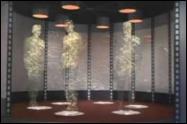
La teletransportación es un sistema que consiste en trasladar objetos o sustancias de un lugar a otro, sin necesidad de moverlos, sino que dividiendo sus componentes. En otras palabras, se trata de tomar un objeto y lograr que en otro lugar del universo aparezca un objeto idéntico, en el mismo estado.
La materia y la energía no pueden ser teletransportadas, pero la "entidad cuántica" de una partícula sí. Por eso, en la teletransportación cuántica no se transfieren las partículas mismas, sino que sus "estados cuánticos", es decir, información que permite "reconstruirlos" casi instantáneamente en otro lado.
· En 1993 la idea de la teletransportación pasó de la ciencia ficción a la teoría. Esto, luego de que el físico Charles Bennet y un equipo de investigadores de IBM confirmaron que la teleportación del quantum era posible, PERO sólo si el objeto sujeto a esta operación era destruido. Y esa es la teoría básica de la teletransportación.
· En 2002, científicos de la Universidad Nacional de Australia consiguieron desintegrar un rayo láser y hacerlo aparecer, casi instantáneamente, más lejos; lograron teletransportar fotones (partículas de luz), 600 metros de longitud, por debajo de las aguas del río Danubio; ¿En términos simples?... lograron que un rayo de luz se produjera idéntico e instantáneamente en dos lugares distintos.
· Lo que los físicos austriacos lograron, así como el equipo de científicos del Instituto Nacional de Estándares y Tecnología (NIST) de Boulder, Colorado, lograron fue teletransportar "estados cuánticos" entre átomos.
ENTONCES:
Cuando los científicos hablan de "teletransportación", se refieren a la transferencia de estados cuánticos, que son propiedades físicas como la energía, el movimiento y el campo magnético del átomo.
· Es la primera vez q se logra con particulas masivas.
Usar la teletransportación como hemos informado podría permitir que se realicen las operaciones de lógica mucho más rápido. Los resultados de los experimentos en EE.UU. y Austria representan un gran progreso en la búsqueda de computadoras ultra-rápidas que podrán transmitir información a la velocidad de la luz.
¿TELETRANSPORTARNOS?
Para teletransportar a una persona primero habría que extraer toda la información que contiene –¿de qué está hecha?, ¿en qué posición se encuentra cada partícula?, ¿en qué estado?–lo cual se podría hacer con algún tipo de medición, digamos, por medio de un aparato que, como un escáner digital, lea y registre toda esa información.
Como estamos hechos de electrones, protones y neutrones, y éstos son iguales en todas partes, no sería necesario enviar a la estación receptora las partículas originales que nos componen. Bastaría con la información de sus posiciones y características.
El problema con la teletransportación es que un principio muy general de la mecánica cuántica –el principio de incertidumbre de Heisenberg—dice, en pocas palabras, que es imposible extraer por medición toda la información acerca del estado y las características de un objeto. Por lo tanto, el escáner imaginario no puede obtener toda la información necesaria para reconstruirnos en la estación receptora. Al parecer, la mecánica cuántica prohíbe la teletransportación.
En 1993 Charles H. Bennett y sus colaboradores idearon teóricamente una manera de usar las mismas leyes de la mecánica cuántica (que impiden extraer por medición toda la información acerca de un objeto) para extraer la información que no se puede medir. Para eso recurren a un efecto cuántico llamado efecto EPR. Con las dos informaciones complementarias se puede construir una réplica del objeto original en otro lugar. Los científicos llamaron al procedimiento teletransportación cuántica.
Paradoja EPR

¿Cómo se explica este fenómeno?
En 1935 Einstein y los físicos Boris Podolsky y Nathan Rosen idearon un experimento imaginario:
Bajo ciertas circunstancias, cuando una partícula es dividida en dos, cada una de las resultantes posee propiedades que están unidas a la otra, sin importar cuán separadas se encuentren. El estado cuántico de una partícula "entrelazada" una vez medida, instantáneamente define el estado de la otra.
Esas partículas forman subsistemas que no pueden representarse separadamente. Cuando una de las dos partículas sufre un cambio de estado, repercute en la otra.
Albert Einstein definió este principio como "una asombrosa acción a la distancia"... el mismo que es utilizado para la teletransportación, ya que las partículas "entrelazadas" pueden ser utilizadas para transferir información de un lugar a otro.
Este efecto de "fotones cruzados" fue la base del experimento de los científicos austríacos: los dos fotones emparejados, enviados en direcciones opuestas, permanecen comunicados entre sí. Al determinarse la polarización de uno de los fotones, puede contarse con que el otro, aunque esté lejos del primero, poseerá la misma polarización.
Y claro, teóricamente, si suficiente información es obtenida de esa forma, puede ser efectiva la teletransportación de objetos, animales y hasta de seres humanos.
Pero de acuerdo a la teoría básica de la teletransportación, ésta podría matar a un ser humano o desarmarlo átomo por átomo, para luego ser reensamblado en otra parte.
Implications of fission, fusion and teletransportation to a
view of personal identity through psychological continuity
Toby Ord

Theories of physical and psychological continuity
1. Classical accounts of personal identity
three main accounts of personal identity: strict identity, physical continuity and psychological continuity.
2. Teletransportation
A prominent example in which there is psychological continuity without bodily
continuity is teletransportation, popularised by Derek Parfit11. Imagine a person, p1, entering a small chamber and typing a place name into a computer terminal. She is then made unconscious with a drug and scanned by a complicated apparatus which records the position and related information about every particle in her body. Her body is then destroyed and the scanned information is sent to another chamber in the desired location. It is then used by a similar apparatus to assemble a person, p2. The drug slowly wears off and p2 wakes up and leaves the chamber. She acts just like p1 did beforehand and says that her ‘transportation’ felt just like falling asleep and waking up again somewhere else.
You see that the person leaving the second chamber is the same person that entered the first chamber, but some have a radically different view, seeing a teletransporter as a high technology killing device that simply creates a replica of the person it destroys12.
There are certainly strong reasons to assume that p2 is p1.
Perhaps provides some surprising insights into personal identity.
One of the more direct implications of this view is that persons can have temporal discontinuities.
There is considerable temptation to deny such a possibility, because of an intuition that objects (and persons) must be spatio-temporally connected.
Science tells us that almost all everyday objects are made of atoms and that these are not connected together by matter.
While this was initially considered an unintuitive consequence of the scientific account of material objects, it is now seen as compatible with our everyday conceptions of objects.
When a body is scanned by a teletransporter and its description is stored, we have also stored a description of the mind. Thus, even in this purely materialist view, a mindstate is still a very different type of thing to a brain-state: it is an informational entity as opposed to a physical entity. At a given moment, the mind can be considered as similar to the information on a compact disc: this information is not the same as the matter of the disc, but rather, it is represented or embodied in that matter.
3. Fission and fusion
The most discussed implication of teletransportation is the possibility that it opens of personal fission13. The simplest fission case is identical to the standard teletransportation case except that the scan is sent to two separate destinations (say Paris and London) which each construct a copy of the traveller, p2a and p2b.
Each of these copies is equally continuous with the original, and thus has an equal claim to being identical to the original person. They can each remember what was done before the transportation, but know nothing of what the other has done since. If they do eventually meet each other, they will know a great deal about the other’s past (since they share a large amount of it) and the general mental characteristics of each other, but they will have grown somewhat apart since the transportation.
since the psychological continuity they possess is a sufficient condition for personal identity. However, as has been pointed in many places, p2a is not psychologically continuous with p2b and there is considerable reason to not consider them to be the same person as each other.
He argues that this concept of survival is what really matters in questions of ethics and rationality.
4. Differences in space-time and psychological continuity views
6. Conclusions
We have seen here many strange implications of psychological continuity when combined with teletransportation. While the cases of simple teletransportation, fission and fusion have often been considered as immediately refuting the view of psychological continuity.
I have also shown several new and interesting cases including causal discontinuities, probabilistic fission and a revised account of fusion, with each case highlighting different and intriguing implications of psychological continuity. My analysis of the types of diagrams used to discuss cases of fusion and fission has shown that these are importantly different to space-time diagrams and that these differences can be used to create new and interesting cases for the psychological continuity view of identity.
El experimento Filadelfia
 El experimento habría sido conducido por el Dr. Franklin Reno (o Rinehart) como una aplicación militar de la teoría unificada o "teoría general de la gravedad" de Albert Einstein. En resumen, la teoría postula la interrelación entre las fuerzas de la radiación electromagnética y la gravedad. Mediante una aplicación especial de la teoría, se creía posible, usando equipo especializado y suficiente energía, curvar la luz alrededor de un objeto, volviéndolo esencialmente invisible. La Marina consideraba este obviamente valioso en caso de guerra (los Estados Unidos estaban participando en la Segunda Guerra Mundial en ese momento) y decidieron aprobar y patrocinar el experimento. Un destroyer escort, el USS Eldridge (DE-173), fue equipado con el generador requerido en el astillero de Filadelfia.
Las pruebas empezaron el verano de 1943, y hasta cierto punto tuvieron éxito al principio. Una prueba, el 22 de julio de 1943, volvió al Eldridge casi totalmente invisible, con algunos testigos reportando una "niebla verdosa" —sin embargo, algunos miembros de la tripulación se quejaron de náuseas posteriormente. En ese momento, el experimento fue alterado a petición de la Marina, con el objetivo de hacer al navío invisible a los radares únicamente.
El equipo fue recalibrado y el experimento se llevó a cabo el 28 de octubre. Esta vez, el Eldridge no sólo se volvió totalmente invisible a la vista, sino que de hecho desapareció del área en un relámpago azul. Al mismo tiempo, la base naval estadounidense en Norfolk, Virginia, a 600 km de distancia, reportó haber visto al Eldridge en sus costas durante varios minutos, al final de los cuales desapareció, para volver a aparecer en Filadelfia, en sus coordenadas originales —supuestamente un caso accidental de teletransportación.
Los efectos fisiológicos en la tripulación fueron profundos. Casi todos cayeron gravemente enfermos. Algunos sufrieron deterioro mental tras la experiencia —en algunos casos se describen comportamientos esquizofrénicos. Algunos otros miembros desaparecieron —supuestamente "desvanecidos"— y supuestamente cinco elementos fueron fusionados con el metal del navío. Horrorizados, los oficiales navales cancelaron el experimento inmediatamente. Todos los sobrevivientes fueron dados de alta; en algunos casos, tras lavarles el cerebro para olvidar los detalles de la experiencia.
The nutley experiment
Amtrek engineers attempted to answer that question with a bold test 20 years ago. Now known as "The Nutley Experiment," it was an ill-fated attempt at teletransportation. Amtrek hoped that the ability to teletransport an entire train might radically improve on-time performance. By moving through transdimensional space, an Amtrek train could avoid single-track freight interference, grade-crossing accidents and rail maintenance projects.Early in 1984, a decision was made to conduct a test. It was held at Amtrek headquarters in Nutley, New Jersey, at 9:15 AM on Wednesday, September 12, 1984. A 4-car test train was "degaussed" to remove its magnetic field and a device called a " Dimensional Flux Transducer Coil" was mounted in each car. In theory, this apparatus would cause the train to disappear and instantaneously reappear at Amtrek's station in Newport News, Virginia - a distance of 390 miles. However, once the coils were energized, something went terribly wrong.Instead of being transported, the train became invisible for five minutes before reappearing in the same spot, surrounded by a green fog. Oddly, the onboard chronometers had recorded the passage of exactly 23 hours, 55 minutes. The train's volunteer passengers expressed a sensation of having traveled for what they perceived as a full day. All complained of fatigue and seemed disoriented and irritable. There were other disturbing observations. The onboard crew members were discovered hiding in an unused coach car, where they appeared to be talking and joking. However, all five employees were surly or unresponsive when questioned. Thirteen of the passengers met a particularly gruesome fate. As far as could be determined, they had rematerialized inside of a Cafe Car that was sold out of food and beverages. They were babbling incoherently but seemed quite irate. Biometric telemetry indicated that the onboard test subjects had spent an entire day on a typical train going virtually nowhere. They were normal Amtrek passengers in every sense.Following this experiment, Amtrek's R&D Department abandoned all attempts at teletransportation. The test train and related equipment were scrapped and the case files were sealed for fifty years. They are closed to public review until 2034.No doubt, some readers will be skeptical. For those who wish to investigate further, this strange incident was chronicled extensively in a 1987 book, "The Nutley Experiment: Fantasy or Fiction?" by Colonel Archibald Adams, USAF (retired). The title is out of print. However, it was republished in an expanded form in 1999 under the title "Phantom Train - The experiment our government wants kept secret." (Dreamfield Press, paperback) The book is a haunting, factual account of this fictitious event.

No hay comentarios:
Publicar un comentario